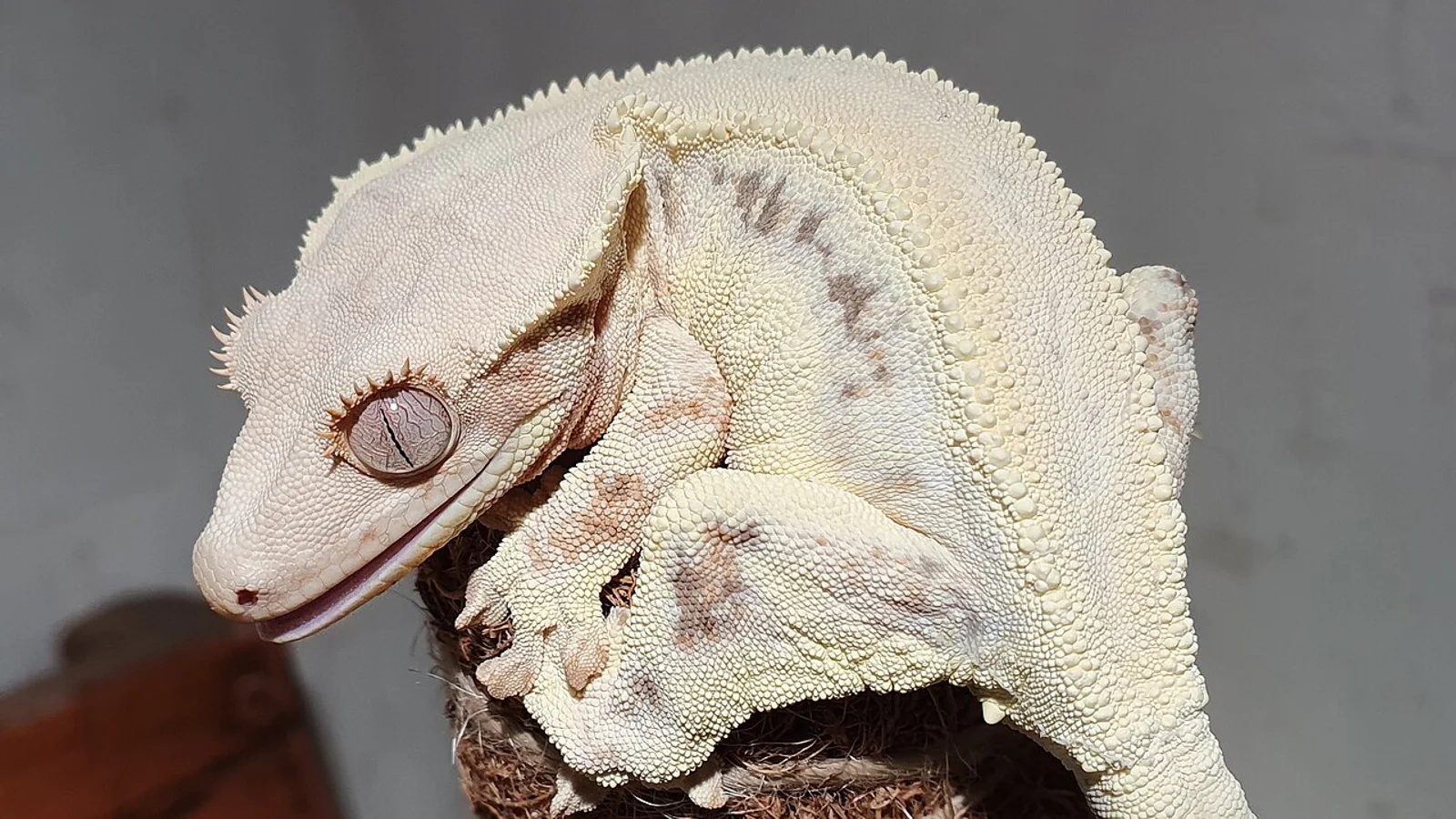
Nearly every new crested gecko keeper hits the same month-two mystery: “Why hasn’t my crested gecko shed once when my friend’s leopard gecko leaves piles of white skin behind?”
Chances are it has shed multiple times right under your nose. Healthy Correlophus ciliatus strip off their entire old epidermis after lights-out in under thirty minutes and eat every fragment before dawn.
Recognizing the four routine phases stops needless stress when your gecko goes suddenly ghostly pale—or ignores CGD the night after swallowing a whole stomachful of shed skin.
The 4 Phases of a Normal Shed Cycle (24–48 Hours Total)
| Stage | Window | Visible Look & Behavior | Keeper Response |
|---|---|---|---|
| 1. Pre-Shed Dull / Milky Phase | 12–36 hours before peeling | Entire body fades into a uniform, translucent gray-white haze; gecko hides deep in foliage and refuses meals | Pause all handling! Separating skin tears easily and wet setae lose grip; mist thoroughly at lights-out to hit 75%–85% humidity |
| 2. Snout Rubbing & Lip Split | 10–15 minutes at night | Gecko rubs its nose softly against rough cork bark or branches until the old layer loosens around the snout | Watch quietly through glass if lucky enough to see it—never reach in to tug or peel |
| 3. Peeling & Eating the Skin (Dermatophagy) | 15–40 minutes | Biting the rolled edge gently, the gecko pulls skin back off head, torso, feet, tail, and every toe tip like peeling off a sweater, chewing as it goes | Leave totally undisturbed; a well-hydrated animal finishes cleanly in one sitting |
| 4. Post-Shed Gloss & Skipped Meal | 1–2 days afterward | Colors snap back vividly fresh; the gecko often ignores food for 1–2 nights after digesting a dense keratin meal | Spend 30 seconds inspecting all 20 toe tips, the tail tip, and eye rims; keep daytime humidity cycling down into 40%–65% (within the 40%–85% cycle) |
Why Do Crested Geckos Eat Their Shed Skin?
Eating old epidermis (dermatophagy) solves two problems in New Caledonia’s tree canopy:
- Predator Concealment: Dropping a bright white skin laced with gecko scent beneath a favorite branch practically maps its hiding tree for snakes and predators. Eating it leaves zero trace.
- Protein & Mineral Recycling: Reclaiming keratin proteins and trace minerals conserves energy—never steal shed scraps away mid-peel.
Typical Shedding Frequency by Age
- Rapidly Growing Hatchlings & Juveniles (0–12 months): Roughly every 2 to 3 weeks.
- Mature Adults (15+ months): Every 4 to 6 weeks for routine epidermis renewal (slowing slightly to 5–7 weeks in older seniors).
Two Habitat Habits That Prevent Stuck Shed
If occasional slivers cling past 24 hours, refine two physical pieces rather than over-spraying nonstop:
- Keep Rough Cork Bark Inside Every Tank: Slick glass and flexible plastic leaves offer zero snout friction. Natural rough cork bark gives instant leverage to split the nose seam.
- Hit the 75%–85% Dusk Mist Spike + Dry-Room Humid Hide: Ensure evening humidity crests cleanly when your gecko turns milky before dropping naturally into 40%–65% by day—especially in dry air-conditioned rooms, where a damp sphagnum moss hide helps tremendously. If minor toe-tip skin sticks past 24 hours, give a 10–15 min room-temperature (
20–26°C / 68–79°F) damp paper-towel sauna box and roll softly with a moist cotton swab—never hot baths.
When small toe-tip shed rings hang on past 24 hours, a ventilated cup with room-temperature (20–26°C) damp paper towel softens them safely in 10–15 minutes.