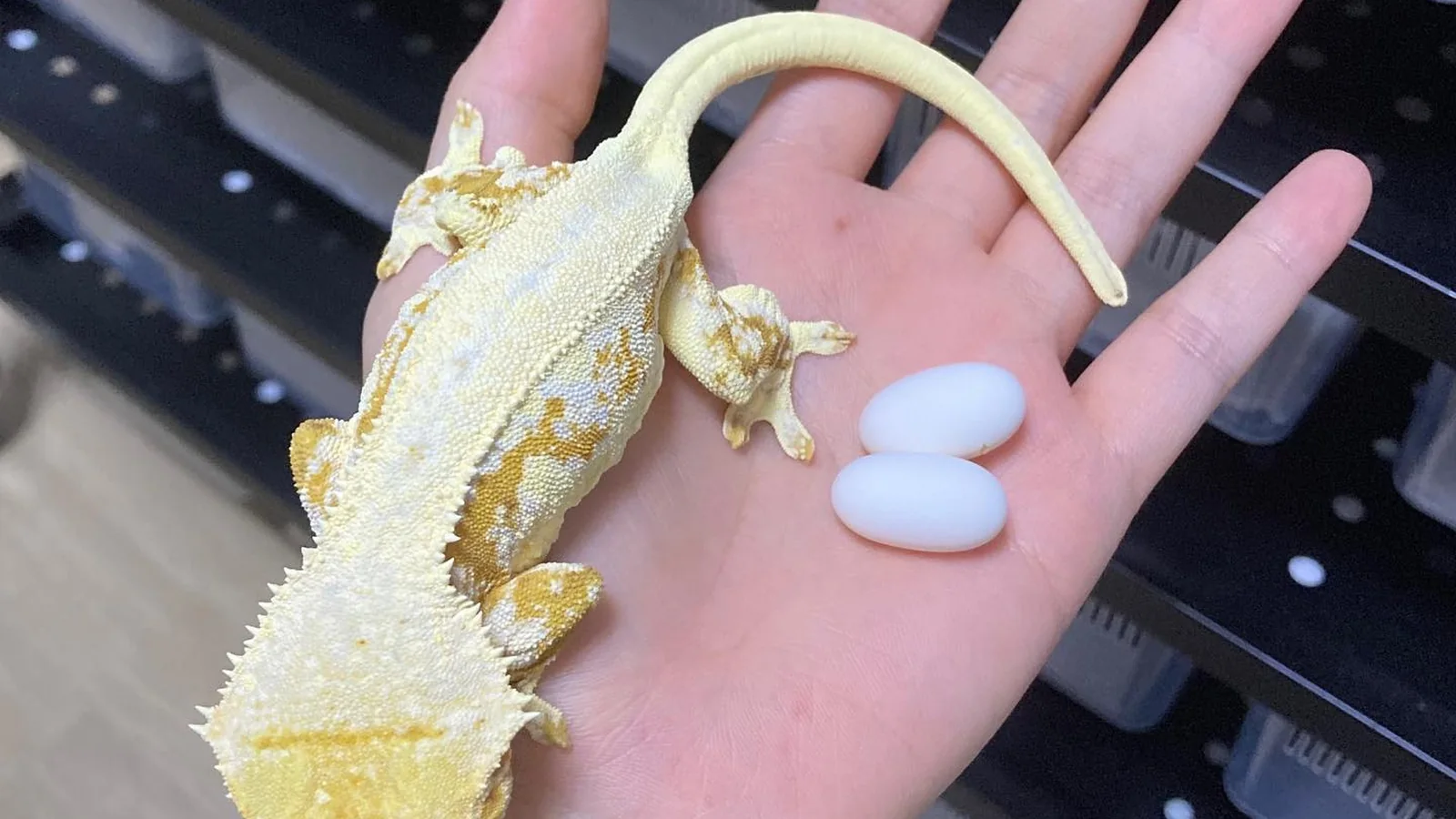
Nothing startles a solo-gecko keeper quite like spot-cleaning a female’s enclosure floor and uncovering two oval white eggs: “Wait—she has never met a male! How did she lay eggs, and are they viable?”
First, take a breath: just like domestic hens, healthy adult female crested geckos ovulate and deposit infertile “dud” clutches roughly every 4 to 6 weeks during warm seasons even without ever seeing a male. Unmated eggs are infertile and can be discarded cleanly, yet solo laying females require the exact same damp lay box and calcium support as paired breeders to avoid egg retention.
For keepers who intentionally pair mature adults, proper lay-box prep, careful candling, and unhurried cool incubation determine whether hatchlings thrive or struggle.
Step 1: Every Mature Female Needs a Moist Lay Box
Once a female reaches 30 to 35+ grams, ovarian follicles begin cycling. Keeping her on bare dry paper towel with nowhere moist and dark to burrow invites retained eggs and fatal dystocia (egg-binding).
- Lay Box Recipe: Cut a smooth 5 cm (2 in) entry hole in the lid or upper side wall of a 15×20 cm plastic tub (8–10 cm tall). Fill 6–8 cm (2.5–3 in) deep with organic coco fiber blended with chopped sphagnum moss dampened until it holds a gentle squeeze with zero dripping water.
- Pre-Lay Behavior Clues: Three to five nights before depositing eggs, she starts patrolling floor corners, digging test tunnels with soil dusted across her snout while tapering food intake. Once she abruptly looks thin again and returns to upper bark, dig carefully through the bottom corners to locate her 2 eggs (occasionally 1 in first-time layers).
Step 2: Candling Eggs & Protecting Orientation
Carry eggs carefully to a dim room and hold a small LED flashlight beside the shell (once you find the top axis, mark it with a soft graphite pencil—never rotate or invert a shelled reptile egg after lay or delicate embryonic membranes tear):
| Egg Condition | Shell Feel & Look | Candling View | Action Required |
|---|---|---|---|
| Healthy Fertile Egg | Firm, symmetrical chalk-white oval with leathery resilience | Warm pink/orange glow with a red circular ring (“Cheerio”) and crisp capillary web | Seat pencil-mark upright, half-buried in 85%–95% moist perlite/HatchRite at 21.5–23.5°C |
| Infertile “Dud” Egg | Flattened, warped, waxy-yellowish, or sticky with damp moss | Solid bright yellow or cloudy off-white glow with zero pink vascular ring by day 7 | Discard cleanly if unmated; check maternal chalk sacs and maintain Pangea / Repashy CGD + dusted feeder crickets |
| Thin / Under-Calcified Shell | Soft, translucent, papery shell denting effortlessly | May or may not show veins, yet shell mineralization failed | Red-Flag Warning: Maternal calcium reserves are depleted. Split any pair immediately, verify fresh Pangea / Repashy CGD (such as Growth & Breeding) & feeder dusting (Repashy SuperCal MeD or plain calcium if optional Zone 1 UVB is fitted), and seek exotic vet advice |
Dark-room side candling shows the pink/red Cheerio ring and spider-web vessels of a fertile egg within days 3–14 versus a solid yellow infertile dud. Never rotate eggs once marked.
(Note: Rare facultative parthenogenesis has been recorded in isolated cases, usually failing or yielding weak offspring, so unmated duds are discarded cleanly. If unexpected paired fertile eggs arrive that you lack space to raise properly, placing fresh eggs into a freezer for 48 hours within 24–48 hours of lay terminates cell division humanely before embryonic vascular development starts.)
Step 3: Forget TSD Myths—Incubate Slowly at 21.5–23.5°C
Use sealed incubation tubs holding pre-moistened perlite, vermiculite, or HatchRite (roughly 1:0.8 water-to-media weight, avoiding condensation dripping directly onto shells):
- Crested Geckos Do NOT Have Reliable Temperature-Dependent Sex Determination (TSD): Unlike leopard geckos, cooler or warmer crested gecko egg temperatures do not guarantee more females or males—do not crank heat upward or chill eggs dangerously chasing sex ratios.
- 21.5–23.5°C (71–74°F) Over 70–100+ Days Builds Better Geckos: Pushing 25.5–26.5°C yields faster hatching (55–60 days), yet rushing embryonic time leaves less yolk absorption and weaker skeletal mineralization, increasing tiny hatchlings and tail kinks. Patient slow incubation at 21.5–23.5°C builds broader crowns, solid frames, and energetic first feeders.
- Never Approach 27°C (80.5°F): Continuous temps at 27.5°C+ spike late-stage embryo mortality and spinal deformities.